
Is AI Replacing DevOps Engineers? The Answer Is More Interesting Than You Think
Is AI going to replace DevOps engineers? We explore how Artificial Intelligence is transforming the DevOps landscape and what it means for your career.
Every few months, a new AI tool is released, and the first question people ask is:
"Is AI going to replace DevOps engineers?"
With tools like GitHub Copilot, Claude Code, Cursor, Gemini CLI, Codex, Warp AI, and cloud-native AI assistants becoming increasingly capable, it's easy to believe that DevOps engineering is becoming obsolete.
AI can now generate Dockerfiles, Kubernetes manifests, Terraform configurations, CI/CD pipelines, shell scripts, monitoring dashboards, and even debug production issues.
So, does that mean DevOps engineers are no longer needed?
Not exactly.
The real question isn't whether AI will replace DevOps engineers.
The real question is:
Are you using AI effectively, or are you competing against people who are?
Let's first understand what DevOps actually is before answering that question.
What is DevOps?
DevOps is a culture and engineering practice that brings software development (Development) and IT operations (Operations) together to deliver software faster, more reliably, and with higher quality.
Instead of developers writing code and throwing it over the wall to operations teams, DevOps encourages collaboration throughout the entire Software Development Life Cycle (SDLC).
Its primary goals are:
- Faster software delivery
- Reliable deployments
- Automation
- High availability
- Better scalability
- Continuous improvement
DevOps isn't a single tool. It's a collection of practices, technologies, and automation working together.
Core Components of DevOps
Before talking about AI, let's understand the major building blocks of modern DevOps.
Linux and Operating Systems
Most cloud infrastructure runs on Linux. A DevOps engineer needs to understand processes, permissions, networking, system services, package management, file systems, shell scripting, and performance troubleshooting. Without operating system knowledge, debugging production systems becomes extremely difficult.
(Coming soon: Learn Linux and Operating Systems)
Containers (Docker)
Containers package an application together with its dependencies so that it behaves consistently across development, testing, and production environments. Docker has become the industry standard because it eliminates the classic "it works on my machine" problem.
(Coming soon: Learn Docker)
Container Orchestration (Kubernetes)
Running one container is easy. Running hundreds or thousands across multiple servers is not. Kubernetes automates deployment, scaling, networking, self-healing, rolling updates, and resource management for containerized applications.
(Coming soon: Learn Kubernetes)
Infrastructure as Code (IaC)
Instead of manually creating cloud resources through a web console, Infrastructure as Code allows infrastructure to be defined using code. Tools like Terraform, Pulumi, and AWS CloudFormation make infrastructure reproducible, version-controlled, and easier to maintain.
(Coming soon: Learn Infrastructure as Code)
CI/CD Pipelines
Continuous Integration and Continuous Delivery automate software building, testing, security scanning, and deployment. Every code change goes through automated validation before reaching production, reducing human error and accelerating releases.
(Coming soon: Learn CI/CD Pipelines)
Monitoring and Observability
Deploying an application isn't the end of the journey. Production systems must be continuously monitored. Tools like Prometheus, Grafana, Datadog, OpenTelemetry, CloudWatch, Azure Monitor, and Elastic Stack help engineers collect metrics, logs, and traces to detect problems before users notice them.
(Coming soon: Learn Monitoring and Observability)
Automation and Scripting
Repetitive tasks should never be performed manually. Shell scripts, Python scripts, PowerShell, and automation tools such as Ansible help automate deployments, server configuration, backups, patching, and operational workflows.
So, How Is AI Changing DevOps?
This is where things become really interesting.
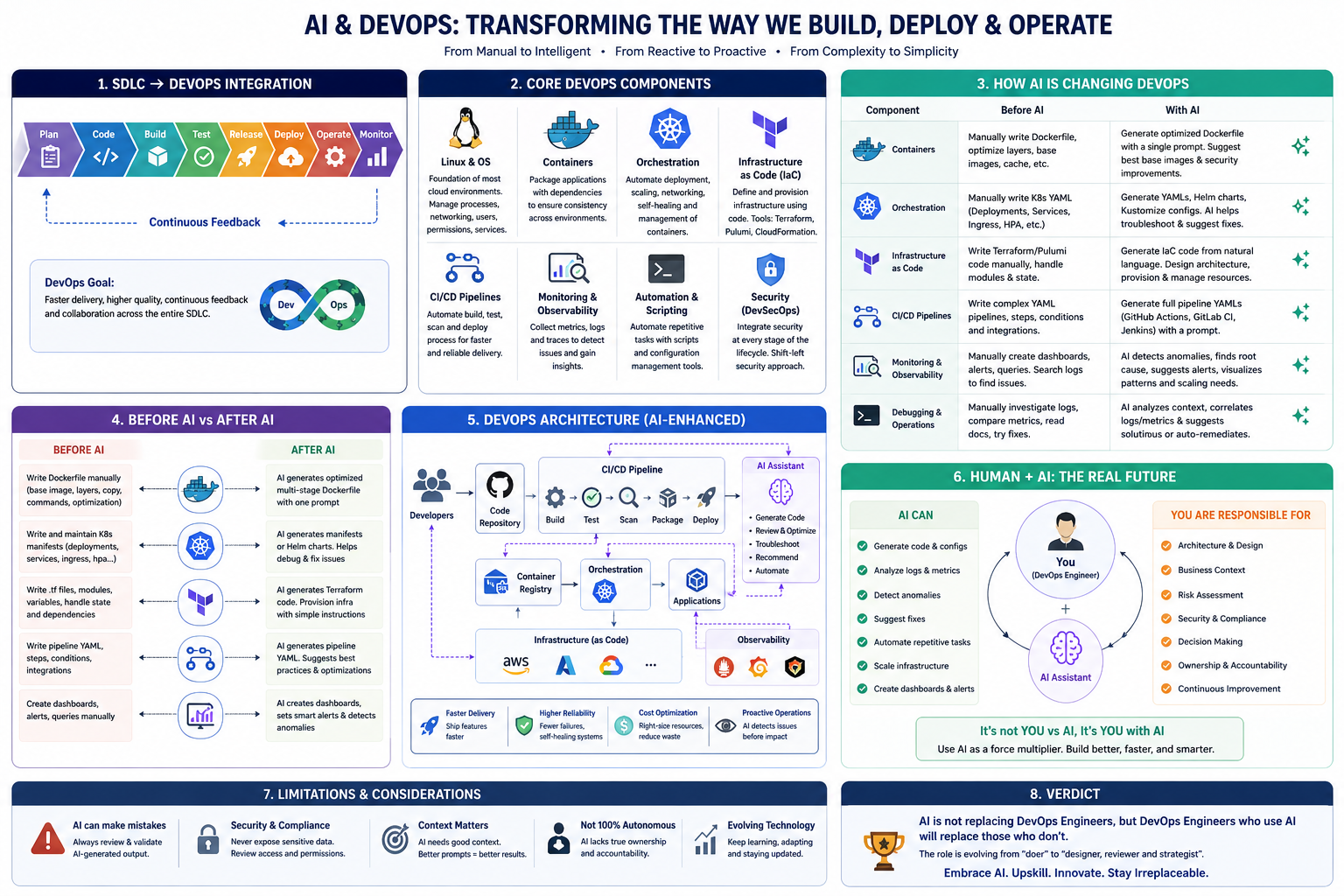
AI isn't changing just one part of DevOps. It's transforming almost every stage of the workflow.
AI and Containers
A few years ago, writing a production-ready Dockerfile required understanding image layers, caching strategies, multi-stage builds, security best practices, and optimization techniques. Today, AI tools can analyze your entire codebase and generate a well-structured Dockerfile with a single prompt.
The focus is shifting from writing Dockerfiles to reviewing and validating them.
AI and Kubernetes
Writing Kubernetes manifests used to take significant time. Now AI can generate Deployment YAMLs, Helm charts, Kustomize configurations, Ingress rules, and Horizontal Pod Autoscalers. Instead of searching documentation, engineers increasingly describe what they want, and AI generates the initial configuration.
AI and Infrastructure as Code
Infrastructure provisioning has become dramatically faster. Whether you're using Terraform, Pulumi, AWS CloudFormation, or Azure Bicep, AI can generate infrastructure configurations in minutes. You simply describe your architecture, and AI produces the initial infrastructure code, which engineers then review and refine.
AI and CI/CD Pipelines
Creating GitHub Actions, GitLab CI, or Jenkins pipelines is no longer a major challenge. AI can generate complete pipelines for building, testing, security scanning, and deploying applications. Instead of spending hours on YAML syntax, engineers can focus on pipeline design and deployment strategy.
AI and Monitoring
Monitoring is becoming far more intelligent. Cloud providers and observability platforms now use AI to detect anomalies, identify root causes, predict failures, and suggest scaling actions. Instead of manually searching thousands of log lines, engineers receive meaningful insights within seconds.
AI and Debugging
This may be one of the biggest improvements. AI can now help investigate Kubernetes deployment failures, CI/CD failures, permission issues, Terraform errors, Docker build failures, and performance bottlenecks. Rather than reading hundreds of documentation pages, engineers can work interactively with AI to diagnose problems much faster.
So... Is AI Replacing DevOps Engineers?
Let's answer the question everyone is asking.
Is AI replacing DevOps engineers?
The short answer is no.
But it is changing the way DevOps engineers work, and that change is happening faster than many people realize.
A few years ago, being a great DevOps engineer often meant spending hours writing Dockerfiles, Kubernetes manifests, Terraform modules, CI/CD pipelines, Bash scripts, monitoring dashboards, and troubleshooting infrastructure manually. These were considered essential day-to-day responsibilities.
Today, many of those tasks can be completed in minutes with the help of AI.
Need a production-ready Dockerfile? AI can generate one.
Need a Kubernetes Deployment, Service, Ingress, or Helm chart? AI can create the initial version.
Need a Terraform configuration for an entire AWS or Azure environment? AI can scaffold it from a simple architecture description.
Need a GitHub Actions or Azure DevOps pipeline? AI can generate the YAML and even explain every step.
This doesn't eliminate the need for a DevOps engineer—it changes what their time is spent on.
Instead of spending hours writing boilerplate configuration files, engineers can focus on higher-value work such as architecture design, security, reliability, performance optimization, disaster recovery planning, cloud cost optimization, and improving developer productivity.
The role is evolving from "configuration writer" to "infrastructure architect and reviewer."
Imagine Two DevOps Engineers
Consider two engineers with the same technical knowledge and the same level of experience.
The first engineer builds everything manually.
They write every Dockerfile from scratch, create Kubernetes manifests one resource at a time, spend hours writing Terraform modules, manually configure CI/CD pipelines, search through documentation, and debug issues by jumping between logs, Stack Overflow, and official documentation.
The second engineer approaches the same work differently.
They use AI to generate an initial Dockerfile, ask it to create a Terraform module, have it scaffold Kubernetes manifests, generate CI/CD pipelines, summarize documentation, explain unfamiliar errors, analyze logs, and even suggest improvements based on best practices.
However, they don't blindly copy and paste AI-generated code.
They review every change, validate security implications, optimize configurations, test deployments, and ensure the generated infrastructure aligns with business and production requirements.
At the end of the day, both engineers produce a working solution.
But the difference lies in how quickly they get there.
One spends six hours writing repetitive configuration.
The other spends thirty minutes generating a solid starting point with AI and the remaining time refining, validating, optimizing, and solving more complex engineering problems.
The second engineer isn't necessarily more intelligent.
They are simply leveraging a better tool.
This Is What Companies Actually Care About
Businesses rarely pay engineers based on the number of lines of YAML they write or how many Dockerfiles they can create from memory.
They care about outcomes.
Can you deploy applications faster?
Can you reduce downtime?
Can you improve system reliability?
Can you automate repetitive work?
Can you optimize cloud costs?
Can you resolve production incidents quickly?
Can you deliver secure, scalable infrastructure without slowing down the development team?
If AI helps an engineer accomplish these goals in half the time, that engineer becomes significantly more valuable—not less.
This is exactly why AI is rapidly becoming part of modern DevOps workflows across the industry.
It's Not About AI Replacing You
Many people frame the discussion as:
You vs AI
But that's the wrong comparison.
The real comparison is:
You vs another DevOps engineer who knows how to use AI effectively.
If two engineers have similar technical knowledge, but one can automate repetitive work, generate infrastructure faster, troubleshoot issues more efficiently, and spend more time solving business problems, it's easy to see who will be more productive.
That doesn't mean the second engineer knows less.
In fact, they often need more knowledge to review AI-generated output, identify mistakes, ensure security, and recognize when AI's suggestions should be rejected.
AI can generate code.
It cannot replace engineering judgment.
The Skill That Matters Most
As AI becomes more capable, the competitive advantage is shifting.
Knowing how to write every line manually is still valuable.
Knowing when to use AI, how to prompt it effectively, how to validate its output, and how to integrate it into your workflow is becoming equally important.
The DevOps engineers who thrive over the next decade won't necessarily be the ones who type the fastest.
They'll be the ones who can combine deep engineering knowledge with AI-assisted productivity to deliver reliable, secure, and scalable infrastructure faster than ever before.
The Biggest Limitation of AI
If AI can generate infrastructure, deploy applications, scale clusters, and debug issues... why can't we simply let AI run everything?
Because infrastructure isn't just about writing code. It's about ownership.
Should AI decide whether to scale production during a traffic spike? Should AI modify firewall rules without human approval? Should AI rotate secrets automatically? In many organizations, the answer is still no.
AI can recommend, automate, and accelerate. But someone still needs to understand the business context, assess risk, make architectural decisions, approve critical changes, and take responsibility when something goes wrong. That responsibility cannot be delegated to a language model.
The Real Future of DevOps
The future isn't:
Human vs AI.
It's:
Human + AI.
The best DevOps engineers won't necessarily be the ones who memorize every Kubernetes YAML field. They'll be the engineers who know what to build, how to validate AI-generated output, when to trust AI, when to question it, and when to take manual control.
AI is becoming a powerful engineering partner—not a replacement for engineering judgment.
Final Thoughts
AI is changing DevOps faster than almost any other area of software engineering. Routine tasks that once took hours can now be completed in minutes.
But faster generation doesn't eliminate the need for understanding. Someone still needs to design resilient architectures, secure cloud environments, troubleshoot complex failures, and make production decisions.
Will AI replace DevOps engineers? Probably not.
Will AI replace DevOps engineers who refuse to use AI? Very possibly.
The engineers who thrive in the coming years won't be those who ignore AI or fear it. They'll be the ones who learn how to use it as a force multiplier.
Because in modern DevOps, it's no longer about you versus AI. It's about you with AI.

Written by
Panda Coding School
AI Engineer & Builder
I build production AI systems and write about what actually works, what broke, and the lessons in between. Follow along for practical AI engineering, no hype.
Enjoyed this article?
Get more AI engineering insights delivered to your inbox.